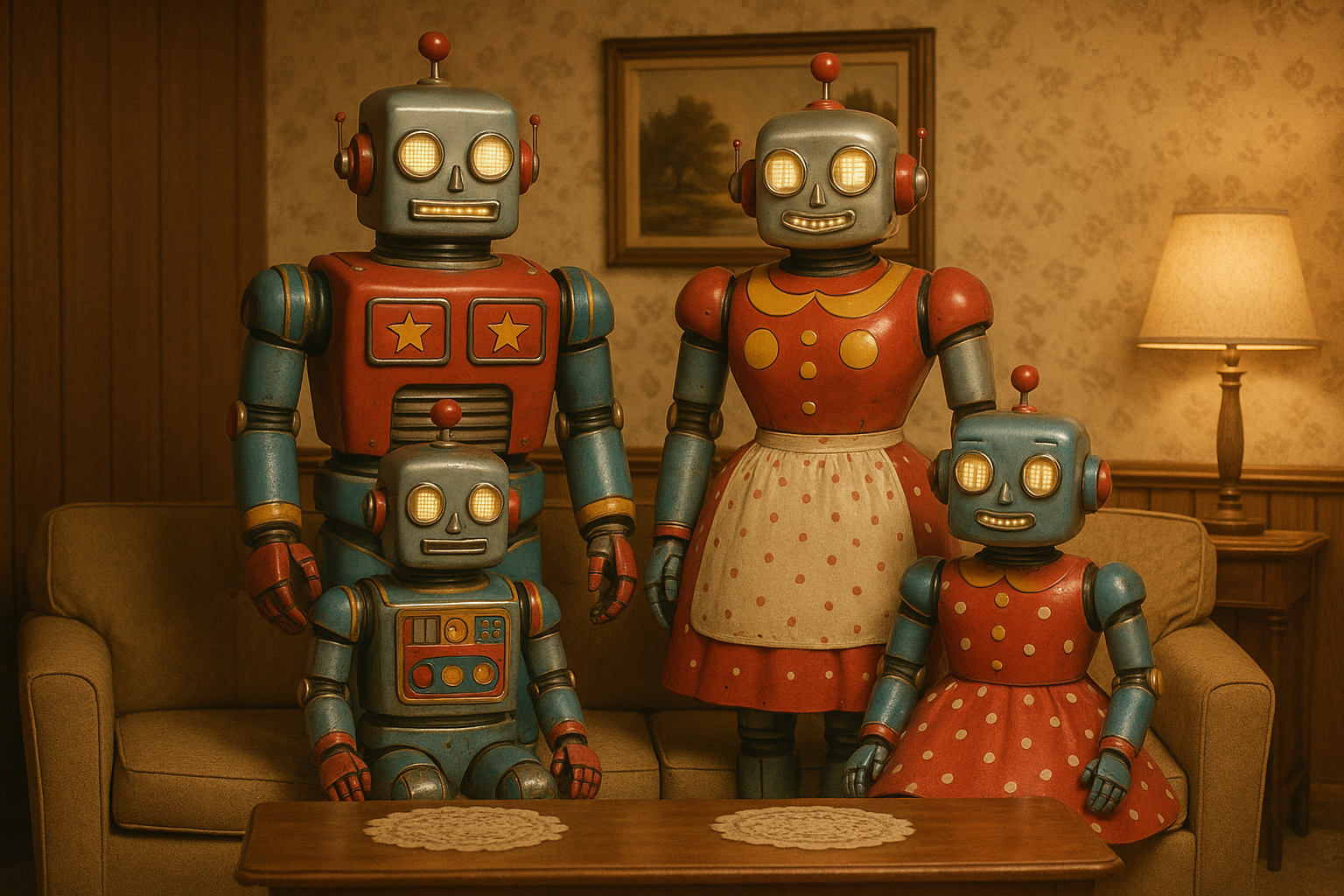
Brands Are Living Beings
Your car smiles at you. Your phone finishes your sentences. Your watch cheers when you move. We’re surrounded by tech brands pretending to be people and we love them for it. This behaviour isn’t a coincidence. It’s a psychological design, an old marketing trick: brand anthropomorphism, the art of making companies feel human.
Brand anthropomorphism transforms products into personalities. The more human our machines become, the more humanly we behave with them. When we say, “My Fitbit nags me,” or “Alexa understands me,” we’re not being cute, we’re confessing attachment.
Marketing scholars started documenting this back in 1998, when Susan Fournier’s landmark study Consumers and Their Brandsrevealed that meaningful relationships require brands to develop distinct personalities. Every piece of modern marketing vocabulary (brand voice, brand image, brand identity) springs from this insight. Nearly a decade later, Pankaj Aggarwal and Ann McGill’s paper Is That Car Smiling at Me? proved: consumers of successfully humanized brands exhibit stronger positive emotions and, crucially, greater anticipated separation distress.
Anthropomorphism is engineered by marketers, through visual cues, verbal patterns, gender assignments, and first-person communication. It’s deliberate. It’s strategic. And it’s the secret weapon behind artificial intelligence’s conquest of the mainstream.
AI didn’t triumph on technical merit alone, it succeeded through superior storytelling, often by accident. In 1943, two researchers called a simple on/off function a “neuron,” giving math a heartbeat. Did it resemble actual brain cells? Barely. But McCulloch, leveraging his neurophysiology background, transformed cold mathematics into something mysteriously biological. In 1956, John McCarthy named the field Artificial Intelligence – for his Dartmouth research funding proposal. The name implied human-like cognition and, thus, secured funding. McCarthy understood that perception shapes reality—especially when grant committees are involved.
Fast-forward to 2022: OpenAI’s first GPT model remained largely unnoticed for ten months. The breakthrough came not from algorithmic leaps but from packaging the technology in a conversational, human-like interface. Now, AI as a category enjoys anthropomorphic advantages by default, the very name suggests human-like intelligence. And as the market matures, we’re about to witness a new kind of tech brand war: not over technical features or server speed, but over personality compatibility. These battles will hinge less on technical merit and more on the product’s ability to build human-like relationship.
It’s a cycle capitalism has played before. In the mid-20th century, as Jack Trout (the pioneer of brand positioning) observed, superior products stopped being enough. Companies moved from touting unique selling points to crafting reputations, and eventually, to owning cognitive real estate. When features and images became indistinguishable, brand success shifted from what you made to how you lived in the consumer’s mind.
AI markets are racing through that same evolution. As capabilities converge and commoditize, positioning becomes the real differentiator, and positioning, ultimately, depends on mastering the psychology of relationships.
Human psychology maps relationships along two primary dimensions: warmth and competence. We trust personalities that balance both traits. Consumer–brand relationships follow the same pattern.
AI’s anthropomorphic positioning delivers competence in abundance. The category radiates futuristic capability but often lacks emotional warmth. Creating true brand love will require both.
The companies that crack this code – humanizing technology while preserving credibility, will capture disproportionate market share. The most successful AI companies won’t just build better algorithms; they’ll craft better user level relationships. In the end, the AI revolution may not be won by the smartest machines, but by the most human brands.